Wednesday, April 17, 2013

The Full Value of Mobile: New calculator and resources to estimate mobile’s value for your business in the new, multi-screen world

We live in a world of constant connectivity, where mobility is bridging the digital and physical worlds. With smartphones in hand, people are taking a variety of online and offline actions, like calling a business, downloading an app, looking for directions to a store, or starting research that leads to a purchase on another device. We’re working hard to account for these new paths to purchase in AdWords, like the recent addition of calls as conversions to AdWords reporting. Still, with more work to be done to improve measurement tools, most marketers still account only for sales happening on a mobile site and aren’t seeing the full picture. Today we’re introducing the Full Value of Mobile initiative to help marketers begin this discussion and better understand mobile’s impact online and offline. 

This new consumer behavior is now the norm, with a recent study showing that nearly three of ten mobile searches result in visiting a store, calling a business, or making a purchase online. Some smart marketers are already investing in understanding how mobile drives sales through these new customer paths. For example, adidas, in partnership with their agency iProspect, felt that mobile was converting in ways beyond their mobile website, so they created a simple yet powerful attribution model to understand how mobile is driving customers into stores. As a result, adidas found that each click on their store locator button was worth $3.20, which has changed the way they view their digital investment. See their full case study here.  

While savvy marketers like adidas are already defining the full value of mobile, most marketers have struggled to get started. To help marketers better understand mobile attribution, we’re launching the Full Value of Mobile initiative, which includes:

  • A calculator tool
  • Videos that illustrate each mobile conversion path
  • Case studies highlighting successful mobile strategies
  • Tips for measurement

T
he Full Value of Mobile Calculator provides simple equations and benchmarks to help you estimate of the value that mobile drives for your business through calls, apps, in-store, mobile site and cross-device. In about 30 minutes, you can follow the step-by-step wizard to upload data from AdWords and your mobile website, and make some key assumptions to create your Full Value of Mobile estimate. Through the exercise, you’ll see the total value, value per click, and ROI that mobile is driving for your business across all mobile customer paths, not just your mobile website. You’ll also see how cost-effective your mobile CPAs are.
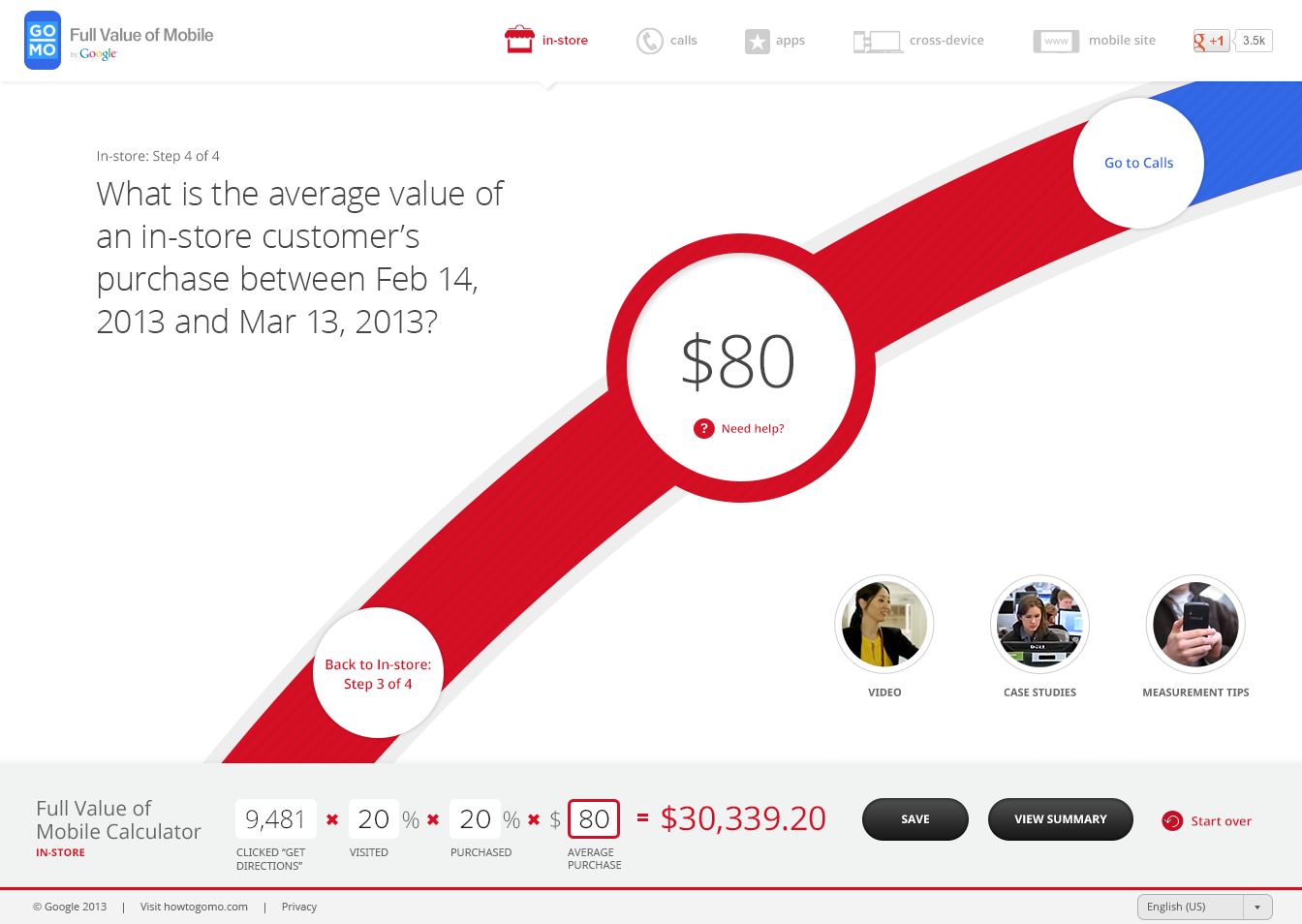


We hope the Full Value of Mobile Calculator helps marketers begin to investigate mobile’s impact online and offline, whether they use it as a directional estimate of mobile’s value or to spark ideas on how to build deeper and more customized models. To learn more about the Full Value of Mobile and how to use the calculator, please join us for a webinar on March 28 at 1pm EDT.  You can sign up here.

Mobility has forever changed the way consumers live and shop, giving rise to these new customer paths as the lines between digital and physical experiences blur. Understanding what each of these mobile pathways means for your business is a critical piece of the larger attribution challenge that every marketer needs to meet head-on. This requires thinking about the full customer journey and acknowledging the interplay between various devices, channels and media influences along the way. Only then can marketers give credit where it’s due – both between and within channels. In other words, rethinking conversion paths is not only key to unlocking the full value of mobile, but also to unlocking the full value of digital.

Posted by Johanna Werther, Head of Mobile Ads Marketing

ValueTrack parameters for enhanced campaigns are live: manage your keyword level URLs by device


Recently, based largely on your feedback, we announced the launch of new ValueTrack features to help advertisers using keyword level URLs achieve specific conversion and ROI goals. These features are now live and ready for you to apply to your campaigns. To recap:
  1. We’re changing the existing parameter {ifmobile:[value]}. Previously, the ifmobile parameter would insert [value] when a user clicked your ad on either a tablet or a mobile device. Now, it will only trigger from an ad click on a mobile device.
  2. We’ve added a new parameter, {ifnotmobile:[value]}, where you can replace [value] with text that will then show up in your URL when the user clicks on your ad from a computer or tablet.
These features will help you achieve your conversion and ROI goals, and make the upgrade to enhanced campaigns easier by:
  1. Directing users to a device-specific landing page at the keyword level.
  2. Aligning performance reporting with device groupings used in enhanced campaigns.
For more information about our new ValueTrack features, please check out our Google AdWords Enhanced Campaign Upgrade Guide - The URL Supplement.

Posted by Karen Yao, Senior Product Manager, AdWords

Large-scale keyword changes made easy with keyword bulk uploads

Monday, April 01, 2013 | 10:54 AM
Labels: 
With our launch of bulk editing back in November, large-scale changes across your entire AdWords account became much easier.  Today, we are launching keyword bulk uploads to help you add, edit and remove keywords at scale.

Have you ever downloaded a keyword report and wished you could make changes to your account directly, without having to upload the report into another tool or go back into the AdWords UI and search for the same keywords you already have in front of you?  Now you can. Right in your downloaded keyword reports, you can add, delete, edit, pause, and unpause keywords, and then upload these changes directly into your AdWords account.

This feature not only saves you time, but it also provides a new level of flexibility and automation by allowing you to use standard spreadsheet functions and logic to manage your keywords.  Here’s an example.  Imagine you want to create exact match versions of all your broad match keywords, and you want to set their MaxCPC bids to be 20% higher than their broad match counterparts.  You can quickly do this by copying the broad match rows, changing the match type column value, and creating a basic formula to multiply the existing bids by 1.20.  Then, you simply upload the entire sheet and AdWords will apply your changes.

Here’s a quick look at how it works:


On the same page where you’ve always been able to download keyword reports, click the box that says “Editable.”  This will download a special, editable version of the keyword performance report that you can modify and then upload.  In order to get the hang of this feature, check out the keyword bulk uploads article in the AdWords Help Center for some basic instructions.

Once you’ve finished making your edits, you are ready to save your changes and upload your report.  You can save your changes in CSV, TSV and Excel formats.  To upload this file, click “Reports and uploads” on the left navigation window, and then click the “Uploads” tab.


It’s important to know that once a bulk upload is submitted, there is no way to cancel or automatically reverse your changes.  Therefore, we recommend that you always save a copy of your original downloaded report in case you ever need to see what your settings were before you made changes and submitted a bulk upload.  You can also view your change history and reverse any unintended changes manually.

For more information on keyword bulk uploads, visit the keyword bulk uploads article or discuss in our AdWords Community.

Posted by Jon Diorio, Senior Product Manager, AdWords

Succeeding with enhanced campaigns

About two months ago, we launched enhanced campaigns to help you more simply and smartly manage your campaigns in today’s multi-device world. Recently we’ve been hearing some great stories about ways that advertisers have improved their performance and saved time with enhanced campaigns. While every advertiser’s business and potential gains may be unique, here are a few examples that highlight actual strategies and results achieved so far with enhanced campaigns. 

e-Travel has improved CTR and conversion rate with context-optimized ads, mobile app downloads, and upgraded sitelinks.

e-Travel is one of the leading online travel agents in Greece, Cyprus and Russia, and has presence in other markets in Europe, the Middle East and North Africa. After upgrading to enhanced campaigns, Managing Director Nikos Goulis reported, “We can now show our ads according to people's context like location or time of day [... and] count app downloads as conversions in AdWords reports, which is very important for us because so many of our new customer leads come from our mobile app. These features along with the upgraded sitelinks helped us boost clickthrough rate by 43% and conversion rate by 88%."


American Apparel has doubled its volume of phone leads with enhanced campaigns, improving return on ad spend.

American Apparel, a multi-channel fashion retailer, upgraded all its campaigns to take advantage of new features like upgraded call extensions and sitelinks. By extending call extensions across all device types, and counting calls over 10 seconds in duration as a conversion, American Apparel has seen their conversion volume from phone calls double. Return on spend has improved significantly. 


A luxury online shopping brand has grown sales by 20% by tapping into secondary markets, thanks to the ease of optimizing bids in multiple locations in a single enhanced campaign.

A luxury online shopping destination had been focusing its search engine marketing efforts on optimizing bids in location-specific campaigns aimed at primary markets like New York City and Los Angeles. Since upgrading to enhanced campaigns, the company started using location bid adjustments to test and expand its AdWords presence in new geographies, including affluent areas of Delaware, South Carolina, and New Mexico. Already, the company has grown total conversion volume by 20% while achieving target return on ad spend. 


Hotwire’s SEM analysts are saving 5-10 hours per week with more efficient campaign management.

Hotwire.com, a leading discount travel website upgraded all of their paid search accounts to Enhanced Campaigns, both domestic and international, within the first month. Clay Schulenburg, Director of Search Engine Marketing at Hotwire shared that upgrading to Enhanced Campaigns really helped his team manage AdWords more efficiently because all the key adjustments for location, time of day and device are now managed in a single campaign: “Time saved per SEM analyst is somewhere in the range of 5 – 10 hours per work week that can now be reallocated to either new strategic SEM initiatives or more granular account/campaign optimizations.”
Get started in 3 steps 
If you’re among the 95% of advertisers whose legacy campaigns currently run across all device types, you can upgrade in just three steps to take advantage of enhanced campaigns: 
  1. Click the “Get started” button when you log into the AdWords interface
  2. Select a mobile bid adjustment
  3. Click “Complete upgrade”
Here's a short video illustration

If you have questions about upgrading to enhanced campaigns, please contact AdWords support, ask for advice from your fellow advertisers in our AdWords community, or check out our comprehensive upgrade guide (.pdf download). 

Share your results and feedback 
Once you’ve started using enhanced campaigns, please let us know about your results and any suggested improvements using our feedback form

Posted by Surojit Chatterjee, Group Product Manager

4 days left for Google Shopping promotional credit

In December, we announced a promotional credit for all eligible merchants in Australia, Japan, Brazil, Czech Republic, Spain, Italy, France, Netherlands, U.K., Germany and Switzerland who create a Product Listing Ad campaign promoting all the products in their Merchant Center account before April 12, 2013. This credit is designed to help international merchants transition to Google Shopping's new commercial model, built on Product Listing Ads. This transition will be complete in June 2013.

With only 4 days left until the April 12th deadline, we encourage merchants in the countries below to learn more about the promotional credit and apply before it’s too late!

$100 AUD
Australia
R$120
1000 Kč
€ 75
€ 75
€ 75
7,500 JPY
€ 75
€ 75
100 CHF
£75


In addition to the promotional credit above, eligible merchants with a Product Listing Ad campaign promoting all products will receive a monthly credit for 10% of their total Product Listing Ad spend up to to June 30, 2013.

To get help setting up your Product Listing Ads, please visit this quick guide, email us through this form or call one of our specialists at your country’s number below.

Google Shopping global phone support:
Australia - 1800 087 124
Brazil - 0800 727 8947
Czech Republic - 800 500 353
France - 805 540 727
Germany - 0800 5894933
Italy - 800930819
Netherlands - 0800 2500026
Spain - 900 814 539
Switzerland - 0800 002539
United Kingdom - 0800 169 0711

You can also join  Google Engage for Agencies on April 10, 9:00AM PST/12:00PM EST to learn how you can help your clients use this beautifully simple experience to better promote their products and attract more customers.


We'll share an overview of Google Shopping, insights into new features, and optimization tips and best practices.

RSVP for the Hangout on Air here.

Posted by Erica Sievert, Product Marketing Manager, Google Shopping

Ad group mobile bid adjustments available soon in enhanced campaigns

People are constantly connected and moving between devices to communicate, shop and stay entertained. Their context – like location, time of day, and device – is an increasingly important signal for advertisers. In February, we launched enhanced campaigns to help you reach people with ads based on their context as well as their intent, all from a single campaign. In just a few short months since launch, we are already hearing enhanced campaigns success stories from businesses of all sizes. 

Ad group mobile bid adjustments
To provide more control and precision over bids in an enhanced campaign, advertisers will soon be able to set a mobile bid adjustment at the ad group level. This functionality will be available to all advertisers in mid-May. We think this may be useful if you’ve been operating large scale campaigns and found that your optimal bids for some keywords would require significantly different mobile bid adjustments within an enhanced campaign.

Example: A nationwide retail chain currently uses mobile-only campaigns to optimize bids for several hundred thousand keywords. They’ve found that 95% of their keywords in mobile-only campaigns have bids that are 10% lower than in the equivalent desktop campaigns. The remaining 5% of their keywords have very different bid ratios (ranging from 40% lower to 100% higher) based on differences in performance and competition on mobile and desktop. By using the new ad group bid adjustments for mobile, this retailer can better maintain their desired bids and ROI on different devices as they upgrade to enhanced campaigns.

The majority of advertisers will still see the most value in using the existing campaign level bid adjustments in enhanced campaigns, so we recommend that you upgrade now to access all the new features. Upgrading takes an easy 3 steps for most advertisers [video]:
  1. Click the “Get started” button when you log into adwords.google.com
  2. Select a mobile bid adjustment
  3. Click “Complete upgrade”
Upcoming dates
We’ll share more details and tips here on the AdWords blog when ad group level mobile bid adjustments are generally available in mid-May. API access for this feature will be available in early May and announced on the developer blog.

We will begin automatically upgrading all AdWords campaigns to enhanced campaigns starting on July 22, 2013. 

Feedback
Thank you for your feedback on enhanced campaigns. Please continue to share your thoughts with us using this form so we can continue to improve the product.

Posted by Bhanu Narasimhan, Group Product Manager

A healthy advertising ecosystem

Online advertising helps to support the services we all enjoy and enables businesses to grow.  The vast majority of our online publishers are terrific partners we love working with.  But, as always in life, there are a few bad apples.

So, we invest a lot of time and effort in keeping them off our systems. 

1. Policies

Our publisher partners are required to adhere to strict policies, which we regularly update to deal with new issues.  These policies cover how how ads are displayed and how end users view them, as well as what site content is prohibited.  We also work to make sure publishers are treated fairly and know the rules.

2. Automated Technology

Our main line of defense against these bad apples is technology — which enables us to monitor the clicks and impressions we receive, and also to scan both our partners’ sites and downloadable software. These tools operate at the click- and page-levels, so we can pick up bad content and bad practices (like artificial traffic) at a very granular level. 

3. Human Review

We have hundreds of employees around the world who review web pages, test our partners’ downloadable software, and prevent ads from showing on sites that violate our policies. Depending on the severity and persistence of the offense, they may stop ad serving on that page or site, or across the publisher’s entire account.

4.  Advertiser Transparency and Controls

We believe that marketers should have transparency into where their ads are being placed, and control over where their ads appear.  Our clients regularly get reports that show what their ads looked like in the context of a given page. We offer tools such as DoubleClick Ad Verification and Active View, which enable marketers to check whether their ad was served and seen. We also offer granular control, such as the ability to buy various pre-vetted packages of inventory on high-quality sites, and tools to exclude particular sites or categories.  This transparency gives advertisers the power to have their ads appear on the websites that are most appropriate for them. 

Trends and recent developments

The numbers show we continue to make good headway.  We have doubled the rate at which we review publisher inventory — enabling us to deal with bad sites and practices more quickly.  In 2012, we found 17% fewer bad actors than in the previous year — even though we increased enforcement and tightened our policies.

Advertisers are recognizing that we offer a high-quality environment for their ads; this helps to support great experiences for everyone.

To illustrate one ongoing effort, I want to highlight our recent changes in the area of downloadable software.

Downloadable software, such as toolbars that operate in your browser, offers a wide variety of services to users.  Our Software Principles have long guided our approach.

In recent years there have been increased reports of software applications that:
  • Unexpectedly change your default browser, search engine or homepage;
  • Clutter up your browser and screen, or interfere with your web browsing experience — for example unexpectedly inserting ads into your browser;
  • Make it very difficult to remove downloaded software from your device or to restore your defaults;
  • Load additional unwanted software applications to your device; and
  • Access personal information or infect your machine with malware.
For example, in the last 90 days, we have seen over 100,000 complaints about software that changed users’ browser settings or about toolbars that they couldn’t uninstall.  We want to avoid these kinds of bad user experiences.  So we recently updatedour policies and enforcement to ensure that software accessing our services complies with the following rules.  It must:
  • Be pre-approved by Google;
  • Offer one-click, complete uninstall;
  • Provide clear, full disclosure and transparency to people about what is being installed and what changes are being made to their devices;
  • Install itself on only one browser per download;
  • Be bundled with and distributed by only reputable parties who comply with our policies.
It’s simple — we don’t want our programs or services abused in ways that can harm users. We believe that our ongoing efforts to fight abuse will ensure our advertising ecosystem continues to work in the best interests of users, publishers and advertisers.

Posted by Vinay Rao, Ad Traffic & Publisher Quality Operations

Thursday, March 21, 2013

Learn from Google at #SESNY 2013

SES New York (#SESNY) is coming up next week, and just like last year, we hope you’ll join us again in the Big Apple.

During day 1 of SES New York, we’ll be on the expo floor with a custom-built Google classroom as well as part of the main conference sessions. Join us where you’ll learn about the newest need-to-know tools, features, and solutions from Google Analytics, AdWords, Mobile, GDN and DoubleClick Search to help you win in a constantly connected world. Following is a listing of our sessions to help you plan your SES experience. 


Google Solutions for a Constantalny Connected World
Day 1 - Tuesday, March 26th all day in the Expo Hall

10:30-11:30am: Reaching customers whenever, wherever, across any device. Surojit Chatterjee, Lead Product Manager for Enhanced Campaigns
11:45-12:45pm: Understanding the Full Value of Mobile. Brendon Kraham, Director, Global Mobile Solutions
2:00-3:00pm: Engaging with your audience in a multi-screen world. 
3:30-4:30pm: Using DoubleClick Search to manage campaigns across channels and devices. Anthony Chavez, Product Manager for DoubleClick Search

Don’t have a pass yet? Don’t worry. Expo Only passes are free and get you access to our Google classroom. You can also use the code NYGOOGLE which is redeemable for up to $700.00 off a full conference pass.

For attendees of the main conference, Google Analytics team members will be participating in the following sessions:

Landing Page Optimization
Day 1: Tuesday, March 26 from 11:45-12:45pm

Are your search landing pages working hard or hardly working? Landing pages can be the hardest-working part of your search campaigns, or they can kill your lead generation and sales conversion rates. Testing insignificant details such as button colour and headline size won't lead to real lift in your conversion rates. This session will show you what to test, how to analyse your landing pages, and how to get significant revenue lift quickly.

Moderator:
Andrew Goodman, SES Advisory Board; President, Page Zero Media

Speakers:
Justin Cutroni, Analytics Advocate, Google
Angie Schottmuller, Director of Interactive Strategic Planning & Optimization, Three Deep Marketing

The Dawn of Convergence Analytics
Day 1: Tuesday, March 26 from 3:30-4:30pm

The combination of "big data," access to cloud computing, powerful algorithms, and unprecedented visualization capabilities has created an emerging new class of analytics tools for the marketer. It's being called "Convergence Analytics". It's the marketing equivalent of "one ring to rule them all." Though still in its infancy as a discipline, there are many vendors in the market, and their goal is to pull together data sources from multiple touch points from the web and beyond. They're also using advanced data gathering and data regularization strategies to create a correlative dashboard-like experience for the marketer.

Moderator
Adam Singer, Product Marketing Manager, Google Analytics

Speakers:
Andrew Edwards, Managing Partner, Efectyv Marketing
Rand Schulman, Managing Partner, Efectyv Marketing

We hope to see you out at the event, you can find out more details on the conference site

Can’t make it to NY? Be sure and follow Google Analytics on Twitter and Google+ for real-time updates on sessions throughout the day sharing interesting bits from the conference. Google give you more information abouth this event.

Wednesday, March 20, 2013

The brand revolution is underway

As we’ve said before, we’ve entered the next wave of digital marketing, as major brands like L’Oreal, Audi and Kay Jewelers embrace digital media and make it a core part of their marketing strategy.  We’ve seen a 65 percent increase in the last quarter alone in the number of brand advertisers using our brand formats and buying tools.

This influx of brand investment is translating into meaningful results for digital publishers.

  • We looked at the 50 top publishers that enable brand-friendly ad formats on their sites.  Over the past three months we found that, on average, they experienced a CPM increase of 2x or more when running these engagement-driven ads, such as our Lightbox ad, which expands to a full page only after a user has deliberately engaged with the ad. "We've seen CPM increases of more than 3X, and our advertisers love the large canvas and pay for engagement model," says Rich Dredge, Answers.com's Chief Revenue Officer.
  • We’ve seen an overall increase in higher CPMs across our exchange -- in the U.S., CPMs over $5 have increased 24% year-over-year while those over $10 have increased 23% year-over-year. Brand spend is a critical piece of these increases.
Fueling brand adoption
To continue this momentum, we’ve been investing in a suite of brand solutions over the past year to help these advertisers make the most of what digital marketing has to offer:
  • New Ways to Buy -- Last year, we introduced Active View, offering for the first time the ability to not only measure whether ads are viewable, but actually buy based on it. Brands are able to “reserve” a guaranteed number of impressions on brand-friendly sites across the web -- and they pay only for impressions that are viewed. 

    • Over the past year, the number of advertisers using the reserve option has increased fourfold.
    • Nearly two-thirds of those are Ad Age top 100 brands.

  • New Ways to Engage -- Last year, we introduced a new family of brand-friendly, engagement-focused ad formats. Engagement formats are already showing terrific early returns.  For example, L’ORÉAL PARiS was one of the first brands to run a campaign using engagement ads. They ran an expandable ad in Germany as part of their “Beauty Minute” campaign and found that 30% of those who expanded the ad watched the entire 30-second embedded video. 
  • New Ways to Measure -- We’re committed to providing meaningful metrics for brands, measurement that goes beyond just clicks and conversions. Earlier this week, we introduced Brand Lift in AdWords, which will enable marketers to run surveys along with their ad campaigns, to determine how their ads helped their marketing objectives (i.e., whether their ads helped build awareness, increased favorability towards their brand, etc.). Brand Lift complements our other investments in brand measurement, like ActiveView and Active GRP.

Digital media represents an amazing opportunity for both brands and publishers, bringing together sight, sound, motion, interactivity and measurement in ways we’ve never seen before.

Over the coming year, we’ll be continuing to invest in our products and systems that will help brands thrive in the digital space, as well as help publishers capitalize on the shift...so stay tuned for more to come.

Tuesday, March 19, 2013

New ValueTrack parameters for enhanced campaigns: managing keyword level URLs by device

In a multi-screen world, it’s increasingly important for advertisers to show relevant ads based on a user’s context: location, time of day, and device. We launched enhanced campaigns to help advertisers take full advantage of user context, maximizing the effectiveness of their ad campaigns.

We’ve been listening to your feedback, and in the next few weeks we’ll be launching new ValueTrack features for advertisers using keyword level URLs.  These features will help advertisers achieve specific conversion and ROI goals, and make theupgrade to enhanced campaigns easier by:
  1. Directing users to a device-specific landing page at the keyword level.
  2. Enabling measurement of the effectiveness of campaigns by device.
What’s new

We’ve added a new parameter, {ifnotmobile:[value]}, where you can replace [value] with text that will then show up in your URL when the user clicks on your ad from a computer or tablet. We’re also changing the existing ValueTrack parameter {ifmobile:[value]}.  This parameter will now insert the specified value into the URL only if the user clicks from a mobile device.

In this post, we will discuss using the ifmobile and ifnotmobile parameters to direct users to a device-specific landing page.  We will also discuss performance tracking by device, and how the ifmobile and ifnotmobile parameters differ from the existingdevice parameter. 

Example 1: Redirecting users to device-specific landing pages

Responsive web design is often a good fit for advertisers who provide device-optimized experiences to their users. If you must specify different landing pages depending on device, you have two options. If the landing page varies by creative, you can simply create mobile-optimized ads by setting the device preference to “Mobile.”  If the device-specific landing page varies for each keyword, then you can use the ifmobile and ifnotmobile parameters in the keyword-level destination URL.  It is important to remember that if you are using the ifmobile parameter today, it will no longer insert a value into the URL for tablet clicks.  The new parameter ifnotmobile will now insert a value into the URL for tablet and desktop/laptop.

Let’s say you want to send mobile users to "m.example.com/widgets," and desktop and tablet users to "www.example.com/widgets" for the keyword “widgets.”  In this scenario you could set the destination URL for this keyword to:

{ifmobile:m.example.com/widgets}{ifnotmobile:www.example.com/widgets}

Example 2: Tracking performance by device

If you want to track performance by device, the existing device parameter will work for most cases.  Using device inserts an “m”, “t”, or “c” into the destination URL, depending on whether the user clicked from a mobile device, tablet, or desktop/laptop computer. If your tracking system requires different internal ids for the same keyword on different devices, then you may need to use the ifmobile and ifnotmobile parameters.

For the keyword “widgets”, let’s say you have assigned an internal keyword id of “df32” for desktops and tablets and “df33” for mobile devices. You can set the keyword-level destination URL to:

www.example.com/widgets?kwid={ifnotmobile:df32}{ifmobile:df33}

Then, if the user clicks from a desktop or tablet, the landing page is:

  www.example.com/widgets?kwid=df32

and for a mobile click:

www.example.com/widgets?kwid=df33

Success in action

Advertisers are upgrading to enhanced campaigns and seeing strong results.  VivaStreet in France, the 4th largest free classified website in the world, upgraded all of their campaigns within the two weeks after launch.  When they upgraded, they increased their mobile bid adjustment to 125% and saw overall conversions increase by 34%.  After seeing the positive results, VivaStreet went on to increase their mobile bid adjustment to 140%.  By using ValueTrack parameters, you can also direct users to device-specific content and measure the effect it has on conversions.

We appreciate the feedback we have received on enhanced campaigns and encourage you to continue helping us understand how to make a great product.  Please join us on March 21st at 10:00AM PST (1:00PM EST) for the latest in our enhanced campaigns webinar series, EC 205, covering enhanced campaigns and the Google Display Network.